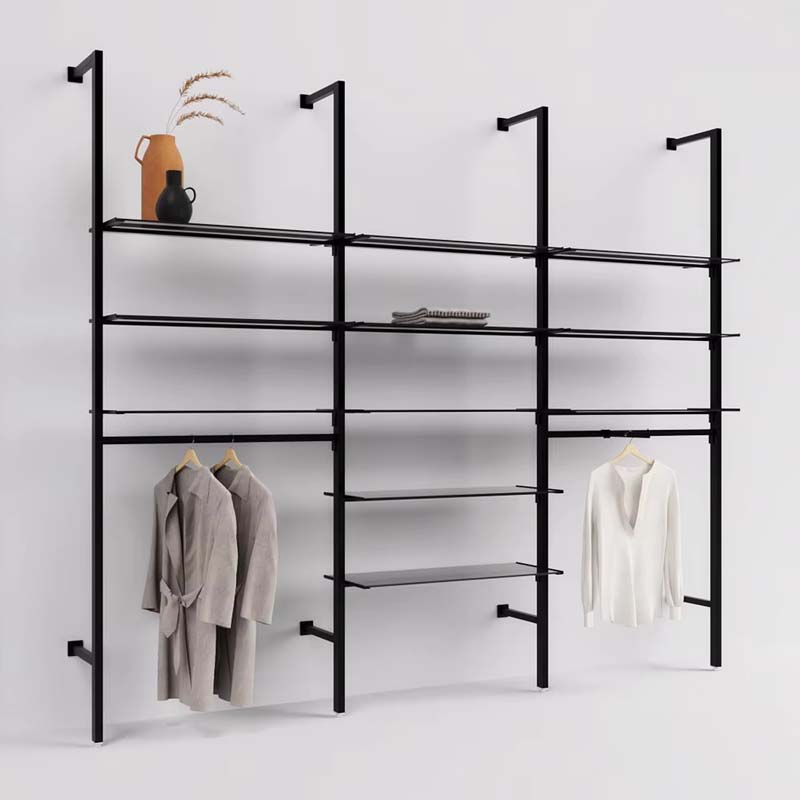

Custom POP displays work best when their materials are selected by function, not appearance alone. Metal commonly forms the structural frame, wood or wood-based panels add a furniture-like brand finish, acrylic creates lightweight transparent holders, and glass provides a hard, rigid viewing surface. The right combination depends on merchandise load, shopper contact, store conditions, cleaning, shipping, destination-market requirements, and how consistently the approved fixture must be reproduced.
A point-of-purchase (POP) display is a fixture designed to present merchandise where shoppers discover, compare, or buy it. A custom POP display is developed around a specific product, campaign, store format, or rollout rather than selected from a standard catalog. For buyers planning a multi-store program, the useful question is not “Which material is best?” but “What must each component do?”
Custom POP Display Materials: Quick Comparison
The table below describes common selection tendencies. It is not a load-rating chart, cost ranking, or compliance approval. Grade, thickness, geometry, fasteners, finish, and the assembled fixture determine actual performance.
| Material family | Often selected for | Main questions to resolve |
|---|---|---|
| Steel or aluminum | Frames, bases, uprights, brackets, and slim structural members | Grade or alloy, section, joints, surface preparation, finish, corrosion environment, and finished-fixture testing |
| Solid wood or wood-based panels | Cabinets, shelves, plinths, fascias, and warm branded surfaces | Substrate, thickness, edges, moisture, finish, fastener retention, emissions documentation, and sourcing claims |
| Acrylic (PMMA) | Risers, trays, product cradles, covers, dividers, and sign holders | Cast or extruded grade, thickness, support spacing, scratches, cleaners, heat, edge finish, bonding, and replacement |
| Glass | Doors, shelves, cases, countertops, and protective viewing panels | Glass construction, thickness, supports, edgework, holes, hardware, packed weight, breakage behavior, and applicable safety rules |
When Metal Makes Sense for Custom POP Displays
Metal is often the starting point when a fixture needs a slim structural skeleton, repeated handling, adjustable hardware, or secure attachment points. It can support an open visual design without making every panel appear heavy. However, “metal” is not a complete specification. The World Steel Association notes that steel exists in thousands of grades with different properties, while the Aluminum Association explains that alloying choices affect strength, density, workability, and corrosion resistance.
Steel and aluminum should therefore be selected at the component level. Aluminum can reduce component weight and offers useful corrosion resistance. Steel may suit a particular structural section, fabrication method, magnetic accessory, or project budget. Neither choice produces a reliable fixture until tube or sheet dimensions, welds or mechanical joints, load paths, base stability, and fasteners are defined.
Finish matters too. Powder coating is a dry finishing process that can create a durable protective and decorative surface, but its performance still depends on substrate preparation, coating chemistry, cure, edge coverage, damage, and the service environment. Buyers should approve a finish sample and state inspection criteria instead of accepting “black powder coat” as the entire requirement.
When Wood or Wood-Based Panels Fit the Brand
Wood surfaces can give custom retail display racks a warm, furniture-like character and can accept veneers, laminates, paint, routed details, and concealed storage. But solid timber, plywood, medium-density fiberboard (MDF), and particleboard are not interchangeable. They differ in machining, fastening, edge treatment, moisture response, surface finish, and documentation.
The USDA Wood Handbook explains that wood exchanges moisture with the surrounding air and that coatings slow moisture movement rather than eliminate it. A useful RFQ therefore identifies the substrate, thickness, finish on all relevant faces and edges, expected humidity, storage conditions, and dimensional tolerances. Those details matter more than the generic word “wood.”
For U.S.-bound fixtures that contain regulated composite wood products, buyers should establish whether the EPA’s TSCA Title VI requirements apply and request the appropriate traceable documentation. If an FSC claim is required, specify the intended claim and verify certificate scope and transaction documents. An FSC logo or supplier statement does not automatically certify the entire mixed-material fixture.
When Acrylic Is the Right Transparent Component
Acrylic is useful where the display needs transparent product holders without the weight of an equivalent glass component. It can be cut, machined, bonded, and thermoformed into trays, dividers, risers, covers, and graphic holders. ACRYLITE reports 92% total light transmission and specific gravity of 1.19 for one named clear cast sheet product, but those figures must not be applied to every PMMA grade, color, thickness, or coating.
The design limits are just as important as the visual benefits. Acrylic is less rigid than glass or metal and can deflect if its thickness or support spacing is inadequate. Ordinary uncoated surfaces also require realistic scratch acceptance and cleaning instructions. Ask whether the sheet is cast or extruded, standard or impact-modified, clear or colored, and uncoated or hard-coated. Then validate the adhesive appearance, bent geometry, edge finish, cleaners, heat exposure, and replaceability on a representative sample.
Acrylic is not “unbreakable,” “scratch-proof,” or “heat-proof.” It is a material family whose suitability depends on the selected product and the finished part.
When Glass Is the Better Display Surface
Glass can provide a rigid, hard, highly transparent surface for shelves, doors, countertops, or protected merchandise. This can be valuable in custom glass display cabinets where viewing quality and a durable surface matter. The tradeoff is weight, plus the need to design edges, supports, holes, hardware, and breakage behavior together.
For context, Vitro reports a density of 2.51 g/cm³ and 89% visible-light transmission at 6 mm for its named clear soda-lime float glass. These product-specific figures illustrate why dimensions and thickness must be part of shipping and support calculations; they are not universal data for every glass construction.
Do not specify only “safety glass.” Annealed, heat-strengthened, tempered, and laminated constructions are not interchangeable. The responsible project team should confirm the required construction for the fixture location, user interaction, and destination market. U.S. architectural glazing rules, for example, do not automatically apply to or exempt every retail display simply because it contains glass.
Why Mixed-Material POP Fixtures Often Work Better
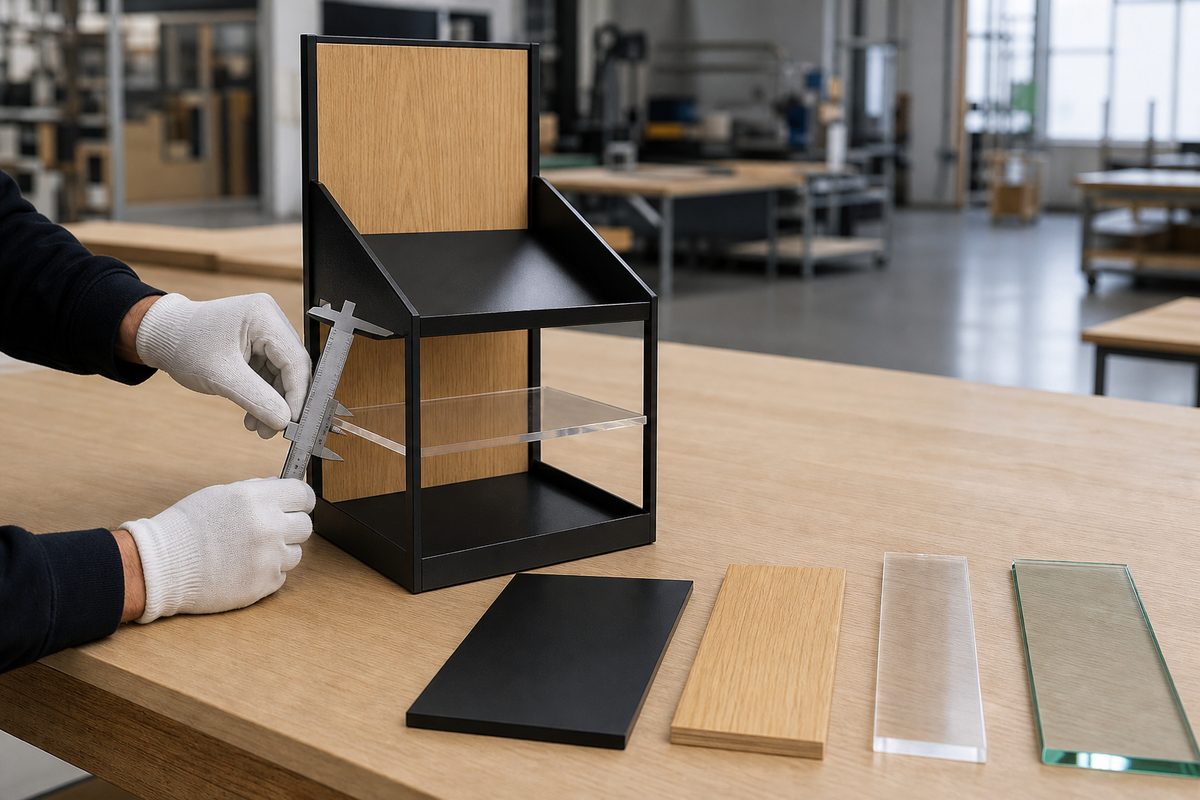
A practical custom display often assigns a different job to each material: a metal frame carries the structure; a wood-based skin delivers the brand finish; acrylic forms removable product holders; and glass protects a high-value viewing zone. This is a design method, not a mandatory recipe.
The engineering work happens at the interfaces. Fasteners must suit both materials. Clearances must account for manufacturing tolerance and movement. Adhesives must remain visually acceptable and compatible with cleaners. Glass and acrylic edges need protection during packing. Wear parts should be replaceable without discarding the complete fixture. The assembled system—not four independent samples—is what must be approved.

Seven Questions That Determine the Right Material
- What must the fixture carry and resist? Provide merchandise dimensions, unit weight, total load, point loads, shopper contact, anticipated impacts, operating cycles, and the required calculation or test method.
- What visual job must the material perform? Define transparency, reflectivity, color, texture, edge appearance, and whether the structure should disappear or become part of the brand expression.
- Where will it operate? State indoor or outdoor use, temperature, humidity, UV, moisture, chemical exposure, and the approved cleaning agents.
- How will shoppers and staff interact with it? Consider touch frequency, door and drawer cycles, movable parts, accessible edges, security, replenishment, maintenance, and replacement.
- How will it ship and install? Define parcel, pallet, or crate routes; packed-size and gross-weight limits; store access; assembly skills; tool limits; and replacement-part plans.
- Which market rules and buyer standards apply? Identify destination markets, composite-wood documentation, safety-glazing analysis, fire or electrical requirements, retailer specifications, and substantiation for sustainability claims.
- How will the approved result be reproduced? Freeze drawings, BOM, grades, thicknesses, finishes, color samples, the approved sample, inspection criteria, packaging, and change-control rules before volume production.
Material Specification Checklist for Your RFQ
- Store type, fixture use, destination markets, rollout quantity, and target installation date
- Merchandise dimensions, unit weight, total load, and load distribution
- Overall fixture dimensions, adjustable parts, and floor, wall, or counter interfaces
- Metal grade or alloy, section, thickness, joints, pretreatment, coating, and color standard
- Wood substrate or species, grade, thickness, veneer or laminate, edges, finish, moisture conditions, and required documentation
- Acrylic product type, thickness, color, coating, edge finish, forming or bonding, cleaning limits, and replaceability
- Glass construction, thickness, edgework, cutouts, supports, hardware, safety analysis, and required marking
- Graphics, adhesives, lighting or electrical parts, and nearby heat sources
- Representative sample tests, drawing and BOM revision, inspection method, and acceptance criteria
- Pack-out, gross weight, pallet or crate limits, handling instructions, and distribution testing
- Approved substitutions, engineering-change process, and spare-parts plan
What Should a Buyer Approve Before Production?
Approve a representative assembled fixture—not a material swatch alone. The approval record should connect the physical sample to controlled drawings, BOM, finishes, graphics, hardware, inspection points, and packaging. If a material or process changes, the supplier should document the change and obtain approval before applying it to volume production.
Kainan can review your merchandise, visual direction, store environment, shipping route, and rollout quantity to propose a project-specific material stack. Explore our custom retail display stands and retail display shelving options, or request a material and fixture assessment. Final specifications, tests, documentation, lead time, and commercial terms should be confirmed for the actual project.
Sources and Scope
Technical references accessed August 21, 2026: World Steel Association; The Aluminum Association; Powder Coating Institute; USDA Forest Products Laboratory; U.S. EPA; Forest Stewardship Council; ACRYLITE; Vitro Architectural Glass; and 16 CFR Part 1201.
Scope note: This guide supports early material selection for custom POP displays. It does not replace project engineering, physical testing, retailer requirements, or legal and compliance review for a specific destination market.