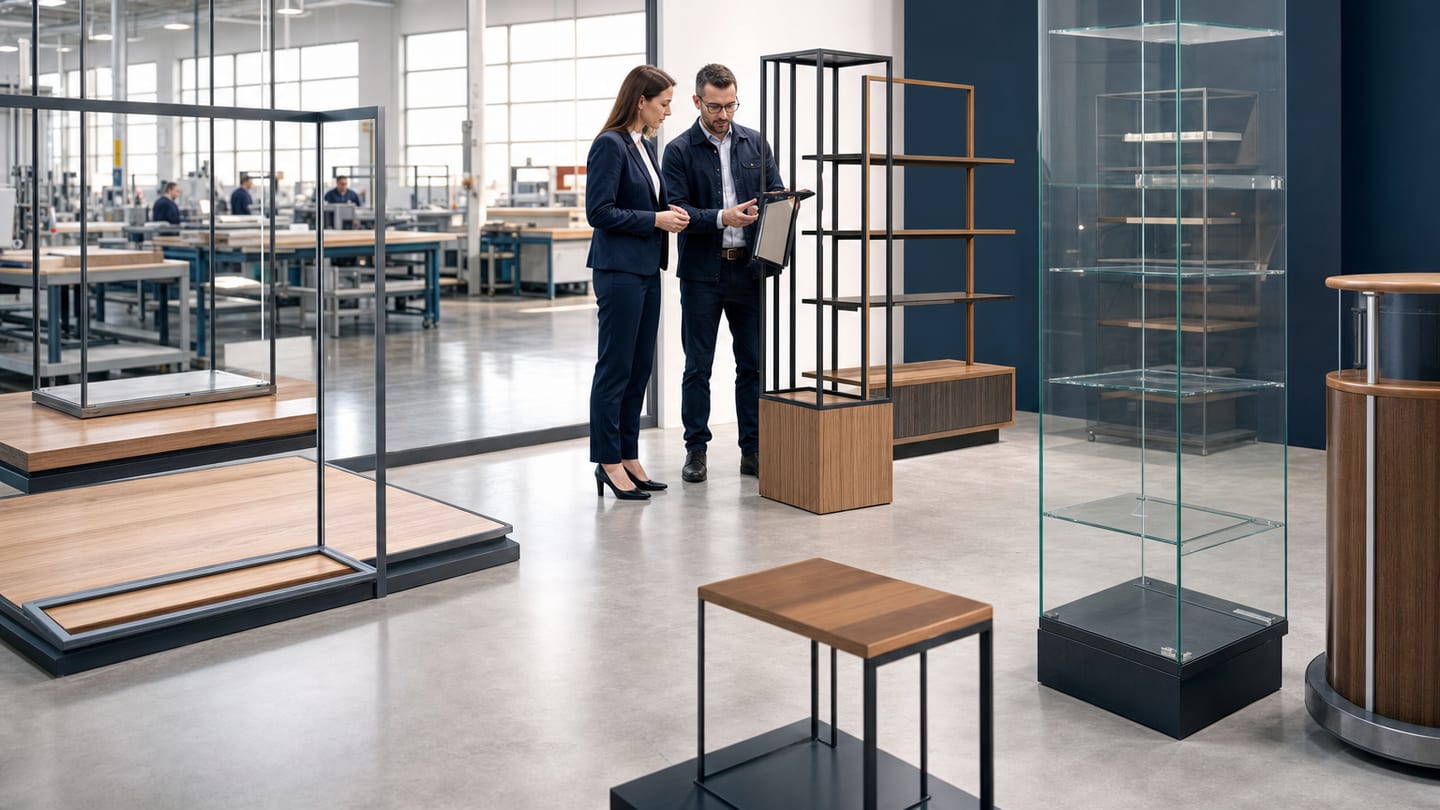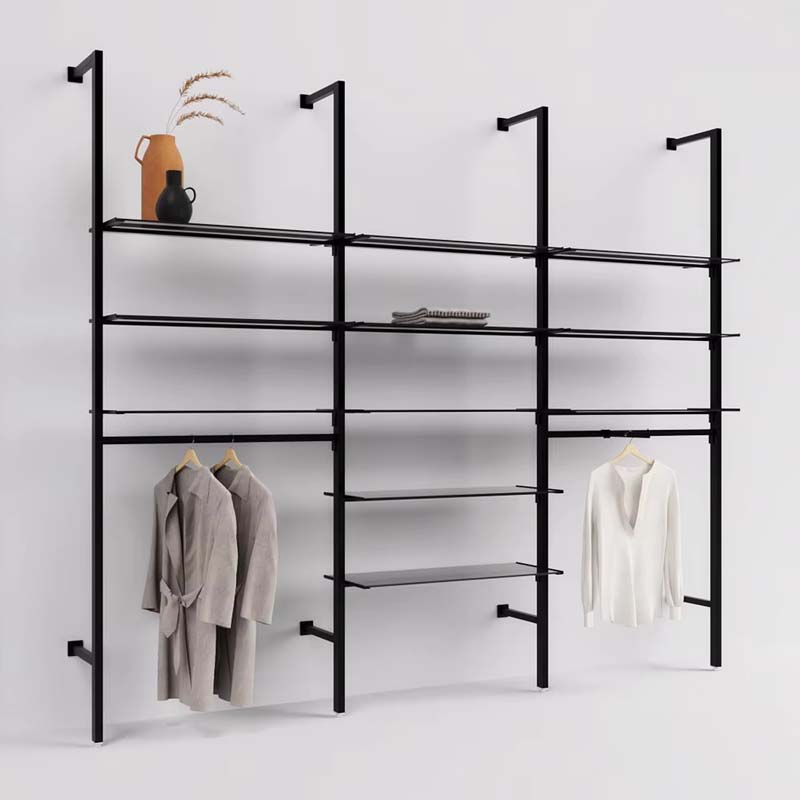

Custom retail fixtures are purpose-designed merchandising or service elements made for a retailer’s products, brand, store format, operating process, and rollout constraints. They include wall bays, gondolas, freestanding displays, counters, cabinets, showcases, tables, racks, kiosks, and modular or temporary displays. A useful specification does more than name the fixture type: it defines the merchandise and loads, replenishment method, shopper and staff interaction, accessibility interfaces, electrical features, materials and finishes, shipping and installation route, and measurable acceptance criteria.
“Custom” describes a fixture developed for a particular project. It does not automatically mean that the fixture is safer, stronger, certified, or suitable for every store. Those results depend on controlled requirements, engineering where needed, representative testing, and an approved first article.
What Are the Main Types of Custom Retail Fixtures?
There is no single mandatory industry classification. Buyers can make a clearer first decision by grouping fixtures according to what they must do in the store.
| Fixture family | Primary job | Questions to resolve |
|---|---|---|
| Wall and perimeter systems | Use vertical store space for shelves, hooks, rails, graphics, or cabinets | Wall construction, anchorage, module pitch, projection, services, and local requirements |
| Gondolas | Create adjustable, double-sided merchandise runs | Bay width, base depth, upright pitch, shelf combinations, loaded stability, and aisle plan |
| Freestanding displays | Create promotional, category, or brand focal points | Product count, center of gravity, footprint, relocation, shopper contact, and service life |
| Counters | Support checkout, consultation, sampling, packing, or service | Customer and staff tasks, equipment, cable management, security, cleaning, and accessible service |
| Cabinets and showcases | Protect or secure products while preserving visibility | Doors, locks, shelf supports, glass or acrylic, lighting, ventilation, and replacement access |
| Tables, racks, and rails | Support open browsing, folded products, hanging goods, or bulky items | Point loads, reach from each side, pull-off behavior, adjustment, replenishment, and leveling |
| Kiosks and interactive displays | Combine a fixture with screens, controls, payment, sensing, or product trials | Device model, power and data, ventilation, accessible controls, service access, and approval route |
| Modular or temporary displays | Reconfigure, flat-pack, relocate, or support a limited campaign | Assembly cycles, fastener retention, intended life, spare parts, transport, recovery, and disposal |
The family name is only a starting point. A custom gondola for boxed cosmetics, for example, does not have the same load cases, security, cleaning, graphics, or replenishment needs as one built for power tools.

Start With the Merchandise and Load Case
A supplier first needs a product matrix: SKU dimensions, unit weight, quantity per facing, orientation, packaging, tester or sample use, security needs, price-label system, graphics, planogram, and likely future product sizes. One “maximum product” is not enough when the geometry and load distribution vary.
Replace vague terms such as “heavy duty” with measurable load cases. State uniform and concentrated loads for each shelf, hook, rail, drawer, and complete bay. Include worst credible off-center loading, door and drawer cycles, shopper pull or push interaction, relocation, assembly cycles, and the wall or floor condition. The specification should also identify who designs, supplies, installs, and verifies anchors.
A load value is meaningful only when it belongs to a defined assembly and test or calculation method. Shelf size, bracket, upright, base, fasteners, anchorage, load position, test duration, acceptable deflection, permanent deformation, and stability criteria all affect the result.
Design for Replenishment, Maintenance, and Changeovers
A fixture can look successful in a rendering and still slow down store operations. Describe who replenishes it, from which side, with what carton, tote, ladder, or tool, how often stock changes, and whether customers must continue shopping during replenishment.
Specify adjustable shelves, removable bins, label replacement, first-in/first-out flow where required, cleaning access, key control, cable access, and replaceable wear parts. Before volume production, observe a representative employee load, clean, adjust, and service the first article with real products and packaging. This small operational trial often reveals blocked doors, awkward shelf angles, loose hardware, or unreachable stock before they are repeated across a rollout.
Check Accessibility Without Applying the Wrong Rule
Accessibility must be reviewed against the actual store plan and scoped elements. Under Section 225.2.2 of the 2010 ADA Standards, self-service shelves, including store shelves, must be located on an accessible route. The same section explicitly states that these shelves are not required to comply with the Section 308 reach ranges. It is therefore inaccurate to claim that every product on a retail shelf must be placed between 15 and 48 inches.
Other elements may have different requirements. Where an operable part is scoped to comply, clear floor space, approach, reach, activation force, and operation may matter. Sales and service counters have their own provisions. Buyers should map accessible routes, checkout and service points, kiosk controls, clear floor spaces, and other relevant elements, then have the owner or responsible design professional confirm federal, state, local, landlord, and project requirements.
Specify Electrical and Digital Features Early
List every powered component: LED luminaires and drivers, receptacles, plugs, power supplies, screens, fans, motors, USB or data connections, sensors, payment devices, and field connections. Define voltage and frequency, maximum input, grounding, overcurrent protection, cord and plug, wiring route, strain relief, ventilation, heat sources, switching, component access, and the party responsible for field connection.
UL Solutions identifies UL 970 as a standard covering commercial displays, retail fixtures, showcases, and temporary displays. That makes it an important applicability discussion for powered or complex fixtures, but it is not proof that every proposed fixture is certified. The retailer, electrical consultant, testing body, installer, and authority having jurisdiction should agree on the required listing, evaluation, and final acceptance path for the real configuration.
Lock Materials and Finishes to Controlled Evidence
A controlled bill of materials should define each component by material family, grade or alloy, panel type, thickness or section, edge treatment, joints, fasteners, adhesives, glass construction, and replaceability. For U.S.-bound finished goods containing regulated composite wood, establish whether EPA TSCA Title VI certification, labeling, recordkeeping, and import requirements apply. If an FSC claim is required, specify the intended claim and verify certificate scope and transaction evidence rather than relying on a logo or general supplier statement.
Color names are not finish specifications. Record a color standard and approved physical master, gloss and texture range, surface preparation, coating or laminate system, exposed-edge quality, graphic registration, acceptable variation, cleaning agents, environmental exposure, and repair method. If an ASTM method is used for coating adhesion or abrasion, state the edition, specimen, conditioning, parameters, sample count, measured result, and pass threshold. “ASTM tested” by itself does not define acceptance.

Design Packaging and Installation With the Fixture
Record the full distribution route before the design is frozen: assembled or knock-down construction, parcel or freight legs, pallet and crate limits, stackability, handling, humidity, shock and vibration exposure, packed dimensions, gross weight, container and store access, elevators, staging space, delivery windows, installer skills, tools, floor protection, anchorage, power or data connection, and waste removal.
ISTA distinguishes integrity screening, partial simulation, and general simulation test families. Select a procedure for the actual packaged weight, configuration, handling, and hazards. Do not request vague “ISTA-certified packaging.” Record the exact current procedure, test level, specimen count, laboratory or test status, and pass criteria. A successful test supports only the product-package configuration that was tested.
Build a Quality Plan Before the Rollout
Approve a representative assembled and loaded first article, not a rendering or material swatch alone. The approval should connect the physical fixture to released drawings, BOM revision, tolerances, finish master, graphics, hardware, electrical documents where applicable, inspection points, assembly instructions, and packaging.
Define critical, major, and minor defects; inspection method and sample plan; measurement equipment; report format; traceability; nonconformance and rework process; spare parts; and field feedback. Keep a golden sample or boundary samples for acceptable and unacceptable appearance. No material, component, or process substitution should enter production without a documented change and written approval.
Custom Retail Fixture RFQ Checklist
- Store format, fixture location, destination markets, retailer or landlord standards, service period, and rollout schedule
- Product matrix: SKU dimensions, weights, packaging, quantities, orientation, graphics, pricing, security, and future product envelope
- Fixture family, overall dimensions, store interfaces, adjustable features, levelers, casters, and anchorage responsibility
- Uniform, point, eccentric, door, drawer, pull, push, movement, and complete-fixture load cases
- Required calculations or tests, parameters, allowable deflection, stability criteria, sample count, and report format
- Replenishment route, carton or tote size, changeover method, cleaning, maintenance, locks, and wear parts
- Accessible route, applicable controls and service points, clear floor spaces, and assigned accessibility reviewer
- Power, lighting, digital equipment, wiring, heat, ventilation, component records, and agreed approval route
- Material by component, grade and thickness, finish master, cleaning exposure, documentation, and substantiated sourcing claims
- Packed configuration, gross weight, distribution route, test plan, store access, assembly, installation, and final sign-off
- Released drawings and BOM, golden sample, first-article report, defect definitions, inspection plan, spare parts, and change control
How Should Buyers Compare Two Fixture Quotations?
Compare quotations against the same released specification, not the total price alone. Check whether both include the same material grades and thicknesses, load and stability verification, finish sample, powered components and approval route, packaging test, installation scope, inspection evidence, spare parts, and change-control process. A lower quotation may simply exclude work or evidence included by another supplier.
Kainan designs and manufactures custom retail display fixtures across multiple fixture families and materials. Buyers can review examples of custom display racks, display cabinets, display tables, and gondola systems. For supplier evaluation, see our retail fixture manufacturer checklist; for material decisions, read the custom POP display material guide. Then send your product matrix and store requirements for a project-specific review.
Sources and Scope
Primary references accessed August 22, 2026: U.S. Access Board — ADA §225.2.2; ADA §§305, 308 and 309; ADA §904.4; OSHA 29 CFR 1910.176; UL Solutions retail-fixture reference guide; U.S. EPA TSCA Title VI; FSC Chain of Custody; and ISTA test procedures.
Scope note: This guide supports early project definition and RFQ preparation. It does not replace project engineering, physical testing, licensed standards, retailer requirements, legal review, or approval by the responsible authority for a specific fixture, installation, and destination.